Andromeda: The rise of real volume on Meta ads
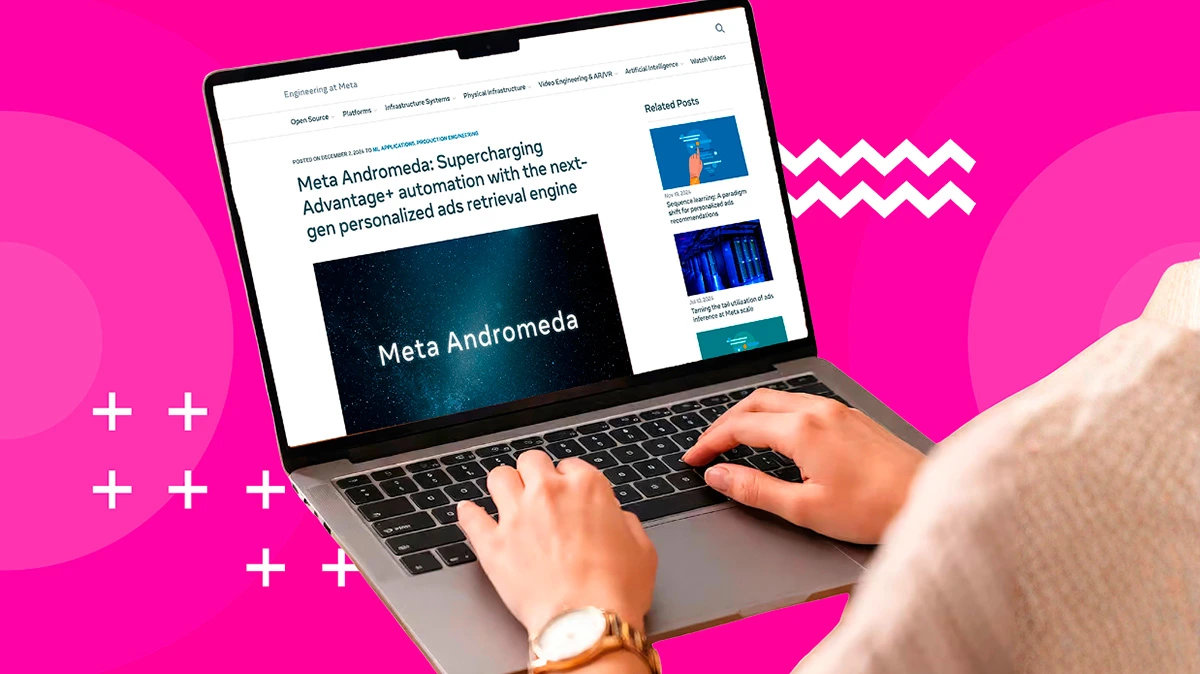
Table of contents
01
What Andromeda actually changed
02
Why 'more ads' is not the same as 'more creative'
03
The brands that are not testing at volume
04
Where the volume comes from
05
The takeaway for the Head of Brand
For most of the last decade, the craft of Meta advertising was the craft of the audience. You built the lookalike, layered the interests, excluded the converters, and split the account into ever-finer cells so that the right person saw the right message. Media planners were, in effect, targeting specialists, and the creative was the thing you dropped in once the audience was right.
That model is over, and most brands still don't understand the implications.
01
What Andromeda actually changed
Its name is Andromeda. Meta introduced it quietly at the end of 2024 and spent 2025 letting it loose across every ad account, and it now decides, before the auction even begins, which ads get a hearing at all. Meta's own published result was an 8% improvement in ad quality, which sounds modest until you understand where in the process it sits.
Andromeda isn't the auction, it's the round before the auction. When someone opens Instagram or Facebook, the system has tens of millions of eligible ads and a few hundred milliseconds to narrow them to a shortlist worth ranking. Andromeda does that narrowing by reading the creative itself, the scene, the face, the claim, the pacing, and matching it to what it knows about that person. Only ads that survive retrieval ever get to compete on bid, budget or audience settings.
The consequence is blunt. Your targeting no longer decides who sees your ad, your creative does. And the retrieval engine can only match a person to a creative that exists.
02
Why "more ads" is not the same as "more creative"
The industry has come to the obvious conclusion, that volume now matters, but real differentiation hasn't been properly understood. In the context of Andromeda a hero film cut to six, fifteen and thirty seconds isn't differentiation. Twelve headline swaps over one photograph isn't differentiation.
Nine placement resizes aren't nearly different enough for the new Ai system to draw from! Systems like Andromeda group semantically similar ads together, so an account holding fifty variations of a single concept is, for retrieval purposes, holding roughly one.
What earns separate consideration is real difference: a different person, a different home, a different occasion, a different reason to buy. That is why the advertisers gaining ground since the rollout are the ones feeding the engine a wide, continuously refreshed library of distinct creative, and letting Advantage+ do the matching that used to be done by hand.



03
The brands that are not testing at volume
This is where a quiet gap has opened in the South African market. Plenty of blue-chip brands still run Meta on a production model designed for scarcity. One shoot a quarter, one hero asset, a cutdown suite, an approvals process built for three assets rather than three hundred. It’s a perfectly rational model for television, but under Andromeda it means the brand is turning up to retrieval with a thin deck of cards, and losing to competitors whose libraries are bigger and more varied, regardless of how good any single execution is.
The instinct is to solve this by scaling the studio. Brief more concepts, shoot more days, sign off more rounds. But traditional production multiplies cost, time and approvals with every additional idea, and the maths stops working long before you reach the volume the system rewards. Nobody ever briefed an agency for a thousand assets, and nobody's budget was built for it.
04
Where the volume comes from
The alternative is to change where the creative originates, not how much of it you commission.
theSalt's Customer-Generated Content turns a production line into a population. Our community consists of roughly 730 000+ real South Africans, everyday content creators rather than professional influencers. Each brings a different face, kitchen, accent, region and occasion to the brief. The diversity Andromeda rewards is structural rather than manufactured, it arrives at a scale a studio cannot reach, and the brand owns every asset outright to run as paid.
For Roman's Pizza, that meant more than 1 375 pieces of authentic content across TikTok, Instagram, Facebook and YouTube in a single six-week, payday-to-payday window, with 100% saturation of the value conversation, a Grade A+ sentiment score of 8.8/10 and a return on ad spend of 10.12x. The deal was not announced once and resized nine ways. It was demonstrated continuously, in real hands, in real homes, by hundreds of different people, which is precisely the type of library a retrieval engine is built to reward.

730 000+
Real South Africans
1 375 pieces
of authentic content
100% saturation
of the value conversation
Grade A+
sentiment score
05
The takeaway for the Head of Brand
Andromeda did not make creative less important. It made one piece of creative far less important than a thousand. The brands that adjust their production model to match will find Meta a more forgiving place than it has been in years. The ones that keep treating targeting as the lever will keep paying more for less, and wondering why.
If you're not in the conversation, you're still being talked about.
Your next campaign is already in theSalt's network
More than 730,000 real South Africans, profiled, verified and ready to talk about brands they genuinely connect with. With theSalt Activate, customer voices are accessible at a speed and price point that changes what is possible.

Albert Makoeng
Albert is a seasoned performance Influencer Marketing expert with 16 years of experience in marketing, media, digital advertising & sponsorship. Albert has held senior positions at DStv, BBC, ESPN and led teams across 20 African markets.


